
Take Me Home, Country Roads: the story of a beloved anthem that became a cult classic
All it takes is the first three chords. At any country evening, in France as in the United States, there is always a song that gets everyone raising their arms and singing along, even those who do not speak a word of English.
For more than fifty years, Take Me Home, Country Roads has held this special place: neither quite a western song nor simply a country hit, but a true popular anthem that spans generations and borders. Understanding where this song came from also means understanding why it remains, even today, one of the most unifying songs in all of American music.
A song born almost by chance, one evening in December 1970
The story begins in an almost uneventful way. In late December 1970, songwriters Bill Danoff and Taffy Nivert were working on a melody inspired by memories of country roads in New England. The song was not originally connected to West Virginia: Danoff simply explained that he did not like "the sound of the word Massachusetts."
Taffy Nivert then leafed through an encyclopedia about the state to find more evocative details, such as the rhododendron, its state flower, and the Blue Ridge Mountains. On the night of December 29-30, 1970, after a concert in Washington, the duo finalized the song with John Denver, who was then a guest performer onstage. Released on April 12, 1971, the song climbed to number two on the Billboard Hot 100, went gold in August 1971, and then platinum in 2017.
John Denver, the troubadour of the great outdoors
Born Henry John Deutschendorf Jr. on December 31, 1943, in Roswell, New Mexico, John Denver began his career in small folk groups before joining the Chad Mitchell Trio in 1965. His solo career truly took off in 1971 with the album Poems, Prayers & Promises, which notably includes Country Roads. Other classics followed, such as Rocky Mountain High, Annie's Song, and Sunshine on My Shoulders, firmly establishing his image as a singer of nature and the great American outdoors.
Committed to environmental causes, he co-founded the Windstar Foundation in 1976 and became Colorado's poet laureate in 1974. John Denver died tragically on October 12, 1997, at the age of 53, when his experimental aircraft crashed over Monterey Bay, California.
What is the song really about?
The lyrics are structured as a back-and-forth between exile and memory. From the very first lines, West Virginia is portrayed as an almost unreal place, a miniature paradise framed by the Blue Ridge Mountains and the Shenandoah River, a land described as old and everlasting, both rooted and alive. This opening immediately establishes the idea of an idealized homeland, seen from a distance, with the slightly hazy tenderness reserved for childhood memories.
The chorus, meanwhile, works like a plea: that of a narrator who, wherever he may be, asks to be taken back along those country roads that lead home. This is the emotional heart of the song, repeated like a mantra, and it is also why it lends itself so well to group singing: everyone, wherever they are, has their own version of the "home" they would like to be taken back to.
The second verse grounds this feeling in more sensory details: a radio crackling early in the morning, mist lingering over the hills, the physical sensation of homesickness suddenly rising, almost against one's will. This is less a postcard than involuntary memory, the kind that appears without warning when confronted with a landscape, a smell, or a song on the radio.
The bridge quickens the pace and heightens the urgency: the road becomes concrete, almost tangible, and the desire to return turns into actual movement rather than simple nostalgia. Then the final chorus brings back the original plea, but carried by everyone at once, which explains why the song so often ends, in stadiums as on dance floors, as a crowd singalong rather than simply a song one listens to.
An anthem played far beyond West Virginia
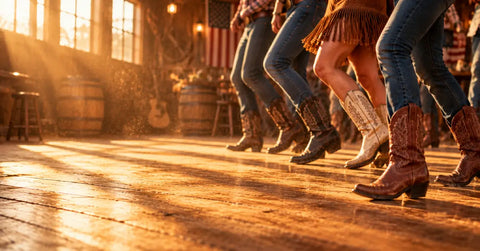
In March 2014, Country Roads officially became one of the four state songs of West Virginia. It has been sung by an entire stadium before every home game of the West Virginia University Mountaineers since 1972, a tradition so strong that it even echoed during events at the 2026 World Cup in the United States. But its favorite setting remains more modest: it regularly closes weddings, karaoke nights, and especially country dance evenings, where it is almost always one of the final songs, the one people sing standing up, arm in arm, before heading home.
Since an evening of this kind rarely ends without it being played, you might as well be ready to experience it in style: our women's western shirts, our cowboy hats, and our women's western boots were designed precisely for evenings like these, without ever looking like a costume.
The next time those opening notes ring out on the dance floor, between two country dance steps and the friendships that begin at country evenings, you will know where this song that makes everyone sing comes from, and why it continues, more than fifty years later, to hold this special place. To continue your musical journey, head to our top 10 iconic country songs or Dolly Parton's biography, another great voice from this world.